
May 2026 | A New Era in Computer Hardware Has Begun
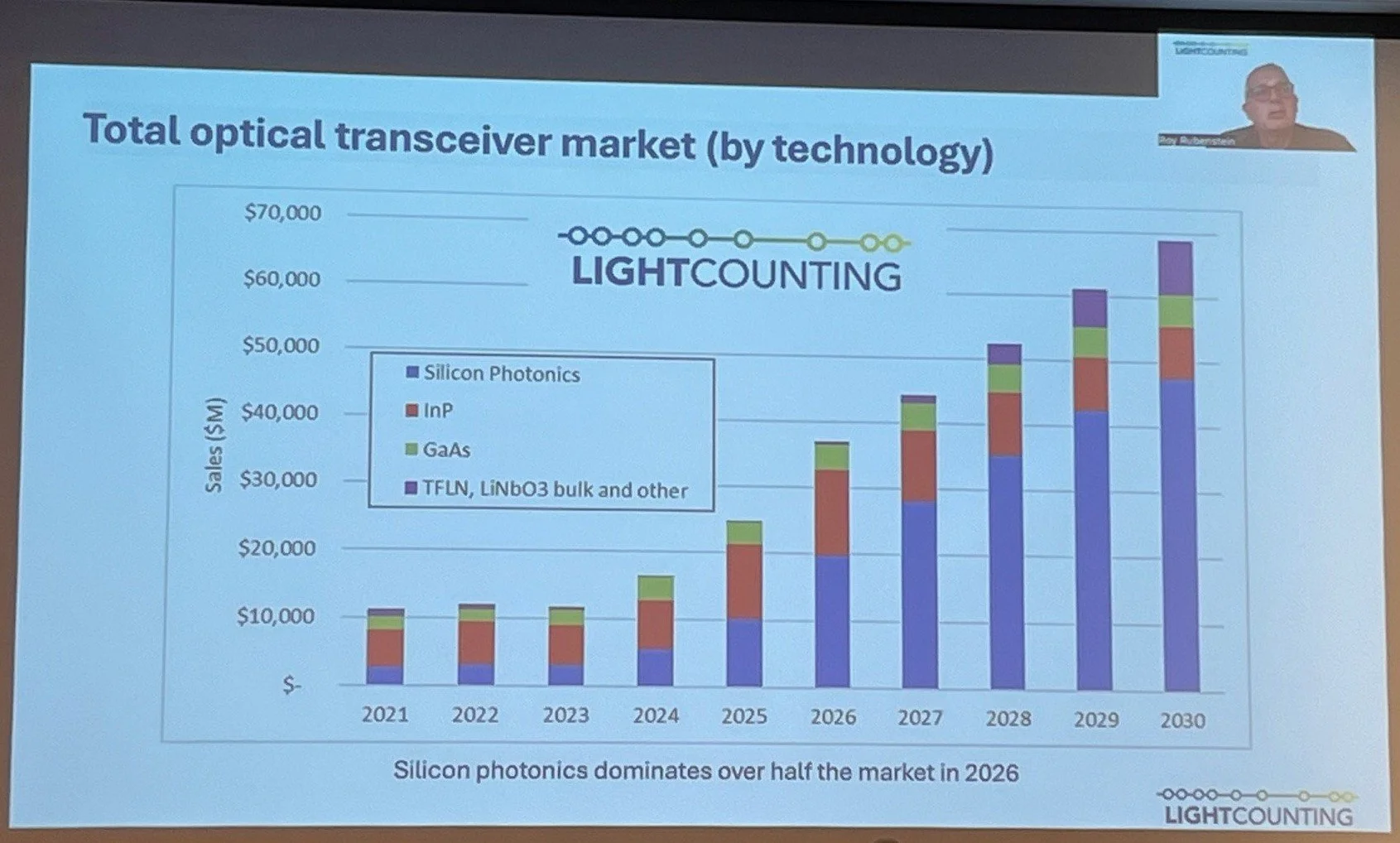
Source: Lightcounting
PIC International 2026 highlighted just how rapidly the photonics industry is evolving to meet the demands of the AI era. Held in Brussels, Belgium during April 21-22, 2026, the event brought together more than 800 attendees and 100 exhibitors. Nearly every presentation was standing room only, reflecting the extraordinary momentum behind optical technologies for next-generation computing hardware.
A central theme of the conference was the massive market pull that artificial intelligence has created for data center infrastructure technology. Traditional copper-based networking hardware has reached its limits in this new world demanding data throughput at terabits per second. The consensus: only photonic networking technology can deliver the data bandwidth and energy efficiency required for future AI data centers. Since ChatGPT’s breakthrough “hello world” moment in 2023, demand for optical transceivers has accelerated dramatically.

Source: IDTechEx
Furthermore, the primary bottlenecks in AI computing are no longer GPU or CPU performance but rather interconnect bandwidth and memory speed. Thermal management at the chip, board, and server levels remain a challenge.
The industry is responding with remarkably sophisticated new compute hardware systems based on heterogeneous integration (mixing of material types and chip technologies), advanced packaging methods and optical I/O architectures.
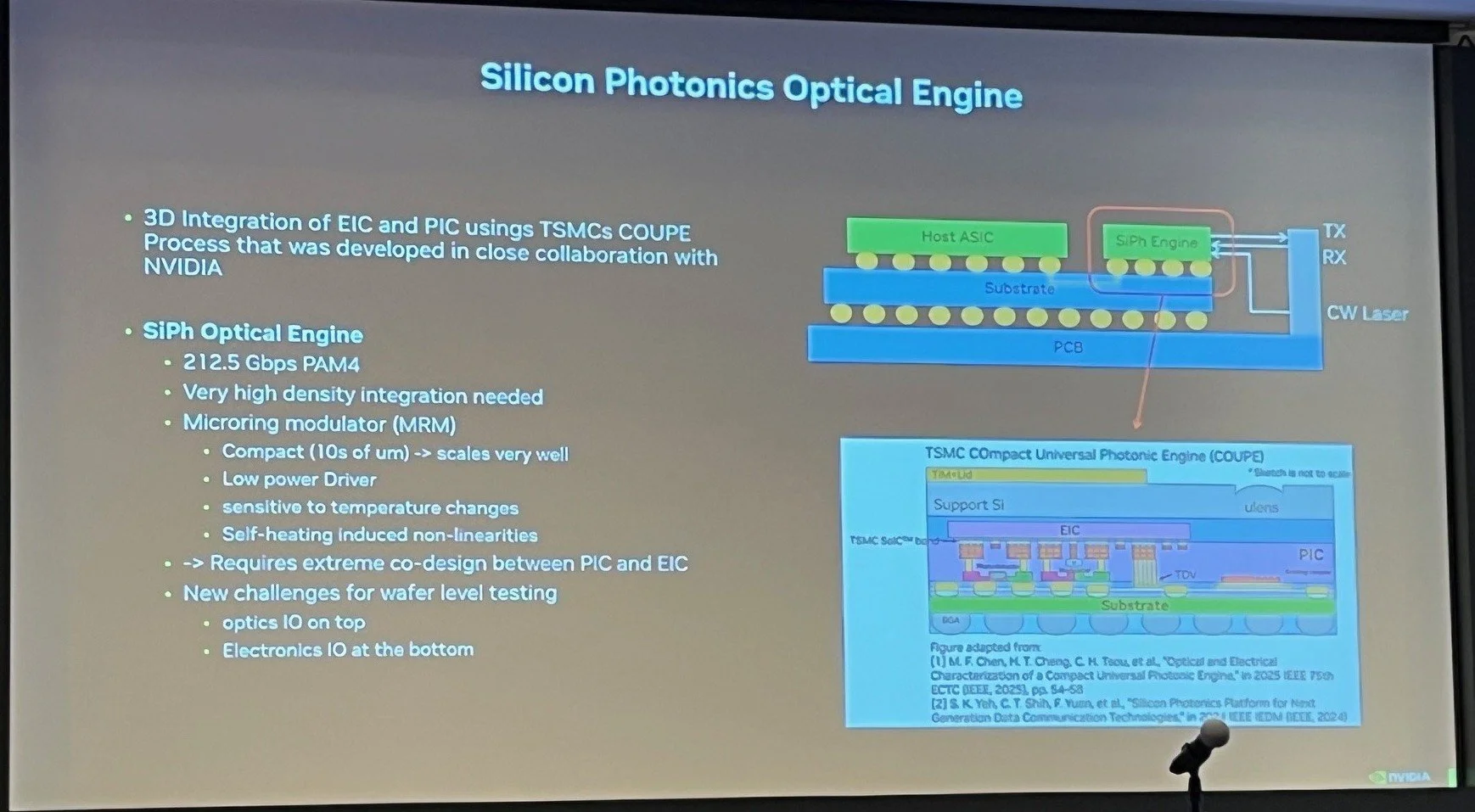
Source: NVIDIA
NVIDIA discussed its collaboration with TSMC on the COUPE (COmpact Universal Photonic Engine) platform, which integrates photonic and electronic ICs using advanced 3D integration approaches. Meanwhile, imec presented work on a 3D optical I/O architecture designed to support data transfer rates exceeding 10 terabits per second.

Source: imec
For AMFitzgerald, the talks we heard at PIC International reinforced a growing opportunity for MEMS expertise in photonics and heterogeneous integration. As compute and optical systems become more dynamic and complex, MEMS technology and methods - including micro-mirror arrays, micro-coolers and precision actuators for photonic components - will play an increasingly important role in the next generation of AI infrastructure.
January 2026 | MEMS + Photonics
When precision motion meets light, magic happens! Read about how MEMS piezoelectric and electrostatic actuators can enhance photonic and optical device performance in Alissa Fitzgerald's article in EETimes.
Photonics West starts next week at the Moscone Center in San Francisco - meet us there. We're excited to see how the latest photonics technology is powering data centers, autonomous cars and advanced medical imaging.
Prior Newsletters: 2025 | 2024 | 2023 | 2022 |2021 | 2020 | 2019 | 2018 I 2017 | 2016 and Older